
Recognizing those on the frontlines: Why climate action must include environmental defenders
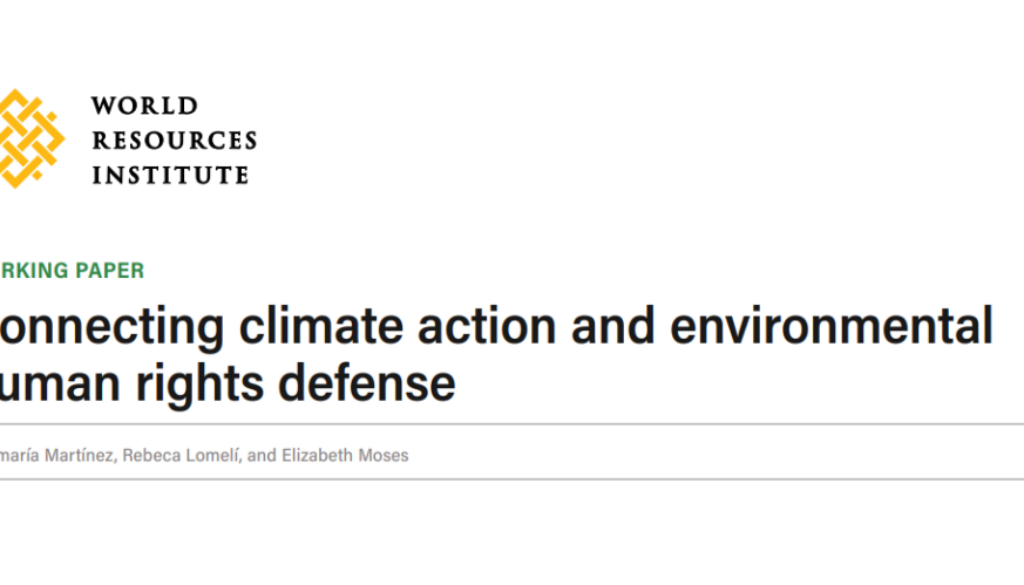
As climate action accelerates globally, a critical group remains largely overlooked in formal decision-making: environmental human rights defenders. A recent report by the World Resources Institute (WRI), Connecting Climate Action and Environmental Human Rights Defense, brings renewed attention to the essential, yet underrecognized, role these actors play in protecting ecosystems and advancing climate solutions.
Environmental human rights defenders (EHRDs) are individuals and communities who safeguard land, water, forests, and biodiversity while defending fundamental human rights. They include Indigenous Peoples protecting ancestral territories, women leading community resilience efforts, youth mobilizing for climate justice, and local communities implementing sustainable land management practices. Their work is not only about resistance, it is also about building viable, locally grounded pathways to climate mitigation and adaptation.
According to WRI’s research, defenders contribute directly to climate outcomes in at least three key ways. First, they help reduce emissions, particularly through forest protection and resisting environmentally destructive activities. Second, they strengthen adaptation by promoting community-based and ecosystem-based approaches rooted in local knowledge. Third, they enhance governance by pushing for transparency, participation, and accountability in environmental decision-making.
Yet despite these contributions, defenders remain largely invisible within global climate frameworks. The report highlights a striking gap: while groups such as Indigenous Peoples, women, and youth are increasingly acknowledged in climate discourse, only a small fraction of the literature explicitly recognizes them as “defenders” engaged in environmental protection. This distinction matters. Recognizing identities without acknowledging the concrete actions and risks involved fails to translate into meaningful protection, funding, or political inclusion.
This invisibility comes at a high cost. Environmental defenders operate in contexts of increasing violence and risk. Globally, thousands have been killed or disappeared in recent years, often while opposing extractive industries or unsustainable development projects. Beyond the human tragedy, this violence undermines climate action itself: when defenders are threatened or silenced, ecosystems lose their most committed stewards, and governments lose access to critical local knowledge and monitoring capacities.
The WRI report argues that integrating defenders into climate policy is not only a matter of human rights, but also of effectiveness. Evidence shows that lands managed by Indigenous Peoples and local communities often experience lower deforestation rates and higher carbon sequestration. In other words, protecting defenders is directly linked to better climate outcomes.
However, current climate governance systems, including processes under the UN Framework Convention on Climate Change (UNFCCC), still fall short. While rights-based approaches are increasingly referenced, there is limited guidance on how to formally recognize, support, and protect defenders within national and international climate policies. As a result, defenders are often excluded from decision-making spaces, underfunded, and left without adequate protection mechanisms.
To address these gaps, the report proposes several key shifts. These include adopting clearer, action-based definitions of defenders; incorporating their contributions into climate reporting and metrics; and ensuring access to funding, legal protection, and participation in policy processes. Ultimately, this requires moving beyond symbolic inclusion toward structural integration.
For networks like KALLIED, and for broader efforts to advance environmental democracy, the message is clear: climate action cannot succeed without those who are already defending the environment on the ground. Recognizing, including, and protecting environmental defenders is not an add-on, it is a prerequisite for effective, just, and sustainable climate solutions.
As global attention turns toward upcoming climate milestones, this report and event serve as an important reminder: the future of climate governance depends not only on ambitious targets, but on the people who make those targets possible.