
Rethinking the energy transition: KALLIED’s contribution to the COP30 Presidency roadmap
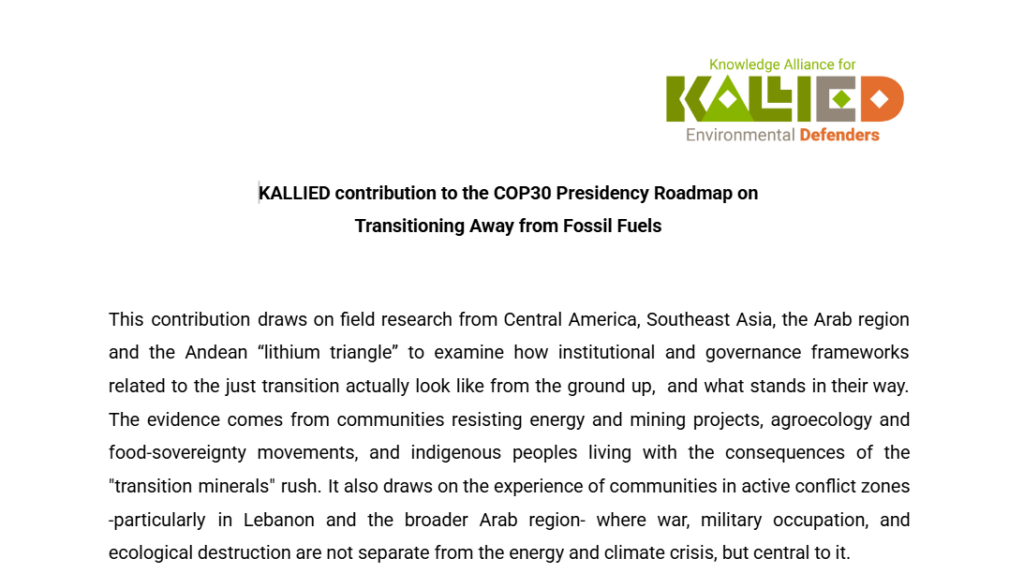
As global climate negotiations move forward, the question of how to transition away from fossil fuels has become increasingly urgent, and contested. In response to the COP30 Presidency’s call for inputs, KALLIED (the Knowledge Alliance for Environmental Defenders) has submitted a collective contribution grounded in the lived realities of frontline communities across the Global South.
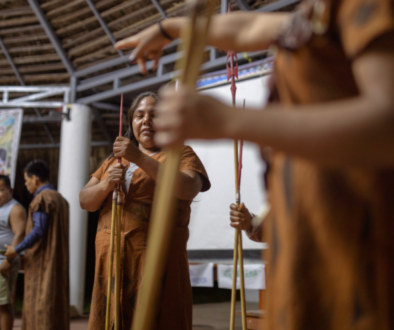
Drawing on research and field experiences from Central America, Southeast Asia, the Arab region, and the Andean lithium triangle, the contribution brings together insights from KALLIED members. Rather than offering abstract policy recommendations, the document centers the perspectives of Indigenous peoples, environmental defenders, and local communities navigating the impacts of both fossil fuel extraction and the emerging “green” economy.
A central argument of the contribution is that the barriers to a just energy transition are not only technological or financial, they are fundamentally institutional and political. Across regions, governance frameworks intended to regulate extraction, protect rights, and ensure participation are often weak, fragmented, or actively shaped by vested interests. In many contexts, environmental defenders face shrinking civic space, criminalization, and violence, undermining the very social foundations required for a just transition.
Importantly, the contribution also emphasizes that the energy transition cannot be understood in isolation from militarization, armed conflict, and geopolitical power. In the Arab region in particular, war, occupation, and ecological destruction are not external to the climate crisis, they are central to it. Environmental degradation caused by military operations, the targeting of agricultural systems and infrastructure, and the destruction of ecosystems represent forms of ecological violence that directly undermine the conditions for any just transition.
At the same time, global climate governance often depoliticizes these realities, treating environmental action as a neutral, technical domain while overlooking how conflict and power asymmetries shape access to resources, energy systems, and decision-making. The continued presence of actors linked to fossil fuel interests and military influence within climate spaces further complicates the picture. As recent analyses from partners such as The Policy Initiative and Arab Reform Initiative highlight, there can be no meaningful climate justice in contexts marked by war, ecocide, and geopolitical control over energy corridors such as the Strait of Hormuz.
At the same time, the document highlights how global climate governance structures can reinforce existing inequalities. Limited access to decision-making spaces, unequal access to climate finance, and the continued influence of powerful state and corporate actors raise critical questions about who shapes the transition, and whose voices are excluded. In conflict-affected regions, these dynamics are even more acute, as instability directly impacts energy sovereignty and access to essential resources.
However, the contribution does not stop at diagnosing the problem. It also identifies a range of concrete levers for accelerating a more just, inclusive, and effective transition. Among these are community-driven advocacy strategies that strengthen participation across the policy cycle, as well as innovative governance practices rooted in territorial realities. Examples include participatory research methodologies, agroecological initiatives, and grassroots coalition-building efforts that reimagine how environmental governance can function.
Importantly, the document calls for structural changes within the COP30 roadmap itself. These include the formal recognition of community and Indigenous governance systems, stronger protections for environmental defenders, and binding frameworks for corporate accountability and human rights due diligence. It also proposes integrating new metrics that go beyond technical indicators, capturing the social and cultural dimensions of transition processes, such as whether affected communities are meaningfully informed and able to shape decisions.
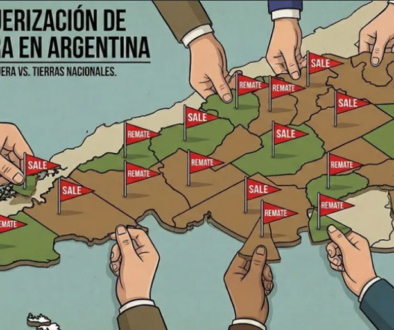
Another key dimension is the need to confront the so-called “green paradox”: the risk that the global push for decarbonization reproduces extractive dynamics in new forms. The expansion of mining for transition minerals such as lithium, copper, and nickel is already generating significant environmental and social pressures in many regions. Without robust safeguards and genuine participation, the transition risks shifting burdens rather than transforming underlying inequalities.
Ultimately, KALLIED’s contribution underscores that a just, orderly, and equitable transition must be deeply contextual. It must reflect the diverse realities of countries at different stages of development, as well as the specific histories, conflicts, and governance challenges shaping each territory. In many cases, communities are not waiting to be included in the transition, they are already practicing alternative models of sustainability, resilience, and care.
For the COP30 roadmap to be meaningful, it must move beyond voluntary commitments and technical fixes. It must engage with the political, social, and ethical dimensions of the transition, including the realities of war, militarization, and ecological destruction, ensuring that those most affected are not only heard but have real power in shaping outcomes. As KALLIED’s contribution makes clear, the success of the global energy transition will ultimately depend on whether it can reach, and be led by, the people and territories that have long been left at its margins.