
Food Sovereignty Is Environmental Justice: Lessons from the Middle East and North Africa
A new dossier by the Arab Reform Initiative explores how control over land, seeds, water, and food production shapes struggles for social and environmental justice across the Middle East and North Africa.
What does it mean for communities to have control over the food they produce, the land they cultivate, and the resources on which their livelihoods depend? In the Middle East and North Africa (MENA), these questions are increasingly inseparable from broader struggles for environmental justice, political autonomy, and the protection of local communities.
Cultivating Sovereignty: Struggles for Food Justice in the Middle East and North Africa, published by our partners at the Arab Reform Initiative (ARI), edited by Julia Choucair Vizoso, and produced by ARI’s Environmental Politics Programme, brings together ten studies examining food sovereignty across the region. Drawing on research from Tunisia, Jordan, Palestine, Lebanon, Iraq, and Syria, the dossier explores how political and economic structures shape food systems, while identifying pathways toward more just and sustainable alternatives.
Its central message is clear: hunger and food insecurity cannot be understood simply as problems of production or supply. They are also questions of power: who controls resources, who makes decisions, and whose needs and knowledge are recognized.
Beyond food security: Who controls food systems?
The dossier distinguishes food sovereignty from conventional approaches to food security. While food security focuses on whether people have access to sufficient, safe, and nutritious food, food sovereignty asks a deeper question: who controls how food is produced, distributed, and consumed?
This distinction matters in a region deeply dependent on food imports and shaped by unequal trade relationships, financial crises, and geopolitical tensions. Reliance on external markets can leave communities vulnerable to price shocks and supply disruptions, while agricultural policies may prioritize export-oriented production and large agribusiness interests over the needs of local populations.
Food sovereignty offers an alternative framework, placing small-scale producers, communities, and their right to shape local food systems at the center. It also connects access to food with control over land, water, and seeds, as well as the ecological conditions necessary for agricultural production.
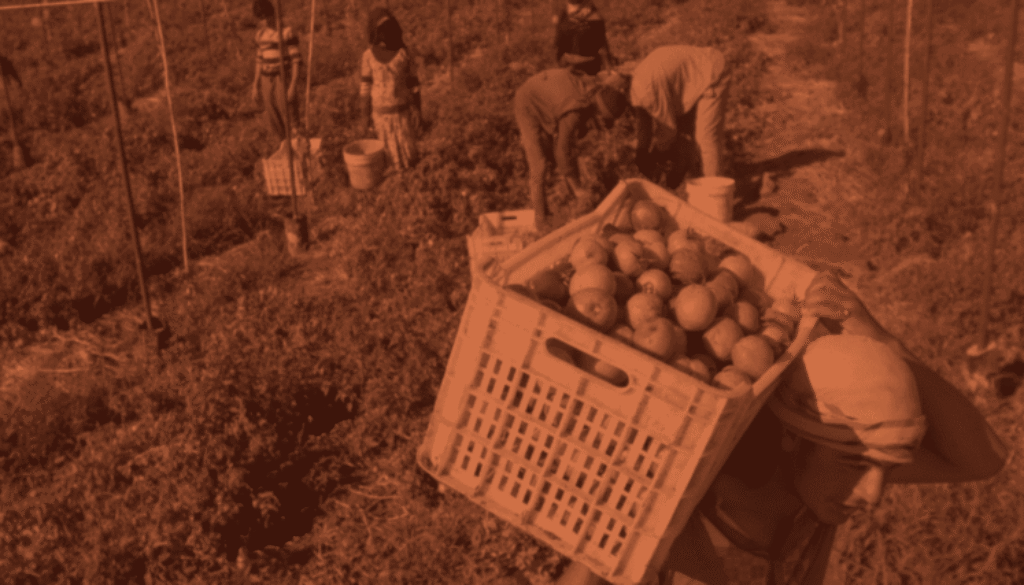
Yet the dossier emphasizes that food sovereignty is not a single, universally agreed model. State-led strategies to reduce food imports may conflict with farmers’ autonomy, while efforts to protect national agricultural interests can overlook migrant workers and other marginalized groups. Building more just food systems therefore requires confronting inequalities within communities, not only dependencies between countries.
Environmental destruction, conflict, and the struggle for survival
One of the dossier’s most urgent contributions is its examination of how war, occupation, and ecological destruction undermine the foundations of food sovereignty.
The destruction of agricultural land and infrastructure, displacement of farmers, disruption of supply chains, and loss of seeds and livestock can devastate food production for years. These impacts extend beyond immediate food shortages: they erode local knowledge, weaken community institutions, and undermine the ability of people to sustain their livelihoods and exercise control over their territories.
The Palestinian case makes these connections particularly visible. Restrictions on access to land and resources, the destruction of agricultural areas, and attacks on local food systems demonstrate how control over food production is intertwined with colonial domination and the struggle for self-determination. The dossier also examines the consequences of ecological destruction for agricultural communities in Lebanon.
These experiences challenge approaches to environmental justice and just transitions that treat war and militarization as secondary concerns. As the dossier argues, environmental protection cannot be separated from the political conditions in which communities live, nor can sustainable development be pursued without addressing violence and dispossession.
For environmental defenders, this connection is especially significant. Defending land, water, seeds, and local livelihoods is not only about protecting ecosystems; it is also about safeguarding the conditions that enable communities to survive, organize, and determine their own futures.
Climate change and unequal access to resources
The dossier also highlights how climate change is reshaping agricultural livelihoods across the region. Prolonged droughts, changing rainfall patterns, and water scarcity place small-scale farmers, fishers, and pastoralists under increasing pressure.
However, these challenges do not affect everyone equally. Access to irrigation, capital, land, and other resources determines who can adapt and who risks losing their livelihood. Farmers with sufficient financial resources may secure water or switch crops, while poorer households face growing insecurity and may be pushed out of agricultural production altogether.
Research on Iraqi farmers illustrates why climate adaptation cannot rely exclusively on technical solutions. Without addressing existing socioeconomic inequalities and the unequal distribution of resources, adaptation policies risk reinforcing the very vulnerabilities they seek to resolve.
The dossier therefore calls for stronger connections between food sovereignty and water justice. It also highlights the importance of recognizing local knowledge and community-led adaptation, rather than treating farmers solely as beneficiaries of externally designed interventions.
Putting communities at the center of change
Across its ten studies, Cultivating Sovereignty identifies a set of priorities for researchers, policymakers, donors, and civil society organizations. These include protecting farmers’ rights to save and share local seeds, strengthening cooperatives, preventing the enclosure and privatization of agricultural land, establishing legal protections for food producers and agricultural workers, and supporting locally grounded approaches to sustainable production.
Equally important is the need to ensure that farmers and rural communities participate meaningfully in decisions affecting their lives. Policies designed without their involvement risk overlooking local realities and reproducing existing power imbalances. The dossier also calls for greater attention to the different interests and experiences of food producers, agricultural workers, and consumers, while identifying opportunities for collective action.
For international donors and development organizations, this means moving beyond technocratic interventions and engaging with the structural conditions that shape food systems, including unequal access to resources, external economic pressures, and political constraints on community autonomy.
Connecting food sovereignty with environmental democracy
For KALLIED, these findings reinforce a broader understanding of environmental defense as a struggle over rights, power, and democratic participation. Communities cannot meaningfully shape their environmental futures when decisions about land, water, and natural resources are made without their participation or when their ability to organize is undermined by violence, exclusion, or economic dependency.
Food sovereignty demonstrates how environmental and social struggles intersect across different contexts. Protecting seeds, defending agricultural land, demanding equitable water governance, and supporting community-led adaptation are interconnected efforts to strengthen communities’ capacity to determine their own futures.
Ultimately, Cultivating Sovereignty invites us to rethink food systems not as isolated technical or economic arrangements, but as political spaces where competing visions of development, justice, and democracy meet. Its lessons extend beyond the MENA region: wherever communities face environmental destruction, resource dispossession, and exclusion from decision-making, the question of who controls the conditions of life remains central.
Building just and sustainable food systems therefore requires more than producing enough food. It requires defending the rights of the people who grow it, protecting the ecosystems that sustain it, and ensuring that communities have the power to shape the decisions that affect their territories and livelihoods.