Who Gets to Shape Climate Action? COP31 and the Rights of Environmental Defenders
Communities challenging mining concessions or documenting damage to water sources are helping shape the future of climate action. Yet the people doing this work often face threats, criminalization, and exclusion from decisions affecting their territories. Climate negotiations increasingly recognize Indigenous Peoples, women, and local communities as agents of change, but recognition of their work as environmental human rights defenders remains uneven.
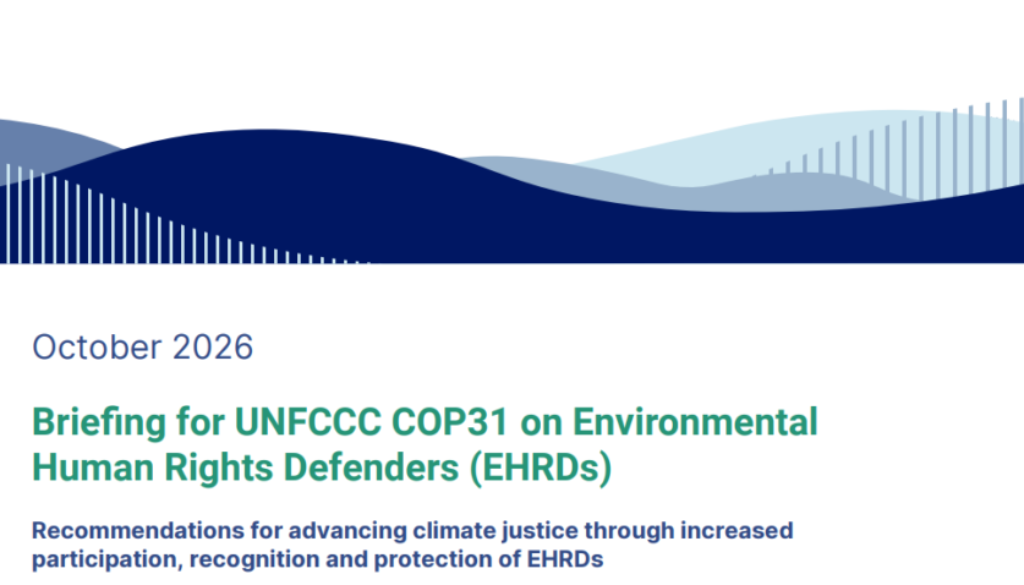
Ahead of COP31 in Antalya, Türkiye, a joint civil society briefing calls on governments and the UN climate system to address this gap. Asuntos del Sur actively contributed through findings generated within Kallied, the Knowledge Alliance for Environmental Defenders, a community of practice connecting nine action-research projects across the Global South. Both are among the briefing’s initiators, alongside international environmental and human rights organizations.
The document places participation at the center of its recommendations: protecting defenders, ensuring their evidence informs negotiations, and making climate policies accountable to the communities affected by them.
From territorial experience to climate policy
A finding from Kallied’s work speaks directly to the challenges facing COP31: formal consultation does not necessarily give communities meaningful influence. The briefing highlights how consultation and free, prior, and informed consent processes associated with mining, geothermal energy, and carbon-market projects in Southeast Asia and Latin America can exist on paper while carrying little weight in decisions.
As climate investment accelerates, this gap has consequences. A project’s contribution to emissions reductions does not settle questions about land rights, consent, or who bears its costs. Where communities cannot access information or challenge proposals safely, climate action risks reproducing existing inequalities. The briefing calls for participation backed by accountability, access to justice, and community-led collective protection.
Six priorities for COP31
1. Make participation accessible and safe
Visa delays, travel costs, accreditation quotas, and closed negotiating rooms determine whose voices reach decision-makers. The briefing calls for transparent accreditation, financial support, reliable remote participation, and formal dialogue between defenders and governments. It also urges the UN climate secretariat to adopt a zero-tolerance policy on intimidation and reprisals, with a designated focal point to follow up on reports. Protection must extend before, during, and after climate meetings.
2. Deliver on commitments to women defenders
The Belém Gender Action Plan recognizes women environmental defenders and provides for guidelines supporting their safe participation and protection. Implementation requires clear responsibilities and resources, with women defenders directly involved in designing those guidelines. The briefing also calls for accessible, grant-based funding for women-led and community-led organizations.
3. Include defenders’ evidence in the Global Stocktake
Beginning at COP31 and concluding in 2028, the second Global Stocktake will assess collective progress under the Paris Agreement and inform subsequent national climate commitments. The briefing argues that this assessment must examine whether climate action respects human rights. Evidence from defenders’ networks and Indigenous Peoples’ organizations should inform its findings, with safe access to technical dialogues and recommendations reflected in future national climate plans.
4. Give public participation commitments practical effect
The review of Action for Climate Empowerment -the UN framework covering climate education, training, awareness, participation, information, and cooperation- offers an opportunity to address civic space. The briefing recommends recognizing defenders as implementers of climate action, funding their work, and documenting barriers to participation. Stronger connections with the Escazú Agreement and Aarhus Convention would link global commitments with regional frameworks for information, participation, and justice.
5. Build rights into the just transition mechanism
COP31 will consider how to operationalize the new just transition mechanism, commonly called the Belém-Antalya Mechanism. The briefing calls for formal roles for defenders and other rights holders in its governance, respect for Indigenous Peoples’ free, prior, and informed consent, and an accessible grievance mechanism with safeguards against retaliation. These provisions matter where renewable energy and transition-mineral projects generate conflicts over land and resources.
6. Assess adaptation through communities’ experiences
Infrastructure and sectoral outputs alone cannot show whether adaptation is effective or equitable. Secure land tenure, access to information and justice, and defenders’ safety also matter. The briefing recommends incorporating these conditions into adaptation guidance, involving communities in technical processes, and ensuring finance reaches the local level. Data should reveal differences between social groups rather than conceal them behind national averages.
Why Antalya matters
COP31 brings together decisions on gender, just transition, adaptation, public participation, and the next assessment of global climate progress. Together, these processes will shape whose knowledge informs policy and how human rights commitments translate into implementation
The briefing connects these negotiations around the conditions defenders need to work safely and influence decisions. Protection is weakened when people remain excluded; participation is hollow without resources or safeguards against retaliation. Through Kallied, Asuntos del Sur brings territorial evidence into this debate, pressing for climate governance that gives communities an effective say over their futures.
The full briefing can be downloaded here.