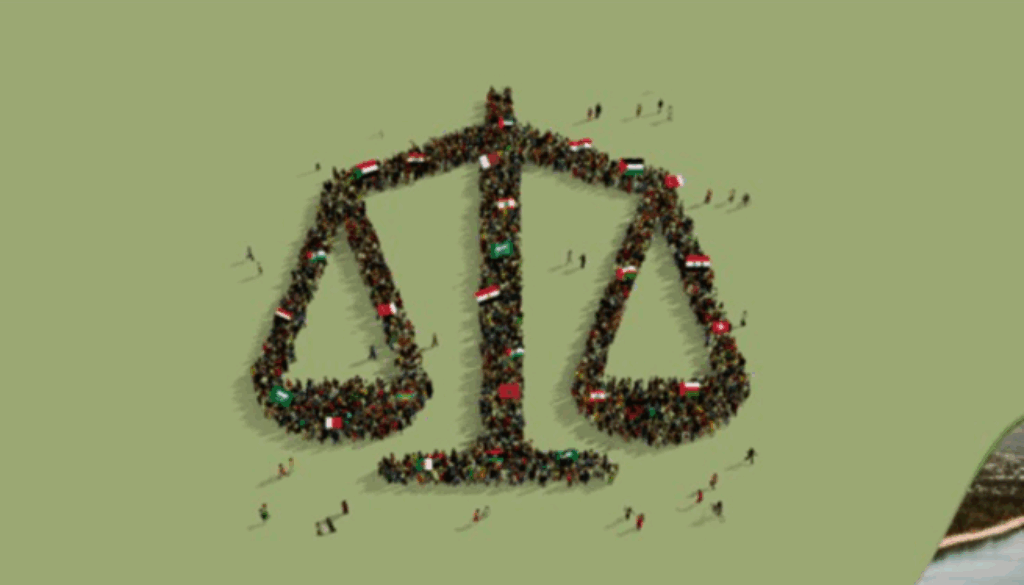
Climate, Land, and Rights: Pursuing Environmental Justice in the Arab Region
Environmental justice depends not only on addressing climate change but also on tackling how land is governed—especially in the Global South. The project that The Policy Initiative (TPI) is carrying out titled “Climate, Land, and Rights: The Quest for Social and Environmental Justice in the Arab Region”, offers a timely and vital contribution to this critical conversation.
Why this matters in the Arab region
The Arab region is among the parts of the world most vulnerable to the climate emergency. Rising temperatures, increasing desertification, declining agricultural yields, and chronic water scarcity threaten livelihoods—particularly for rural and marginalized communities. At the same time, land disputes intensified by «green grabbing» (when land is repurposed in the name of green transitions without fair, communal benefits) or non‑green grabbing (commercial land appropriation under other guises) are becoming more widespread .
These dispossessions can aggravate climate impacts and deepen social inequality:
- Displaced rural communities lose agricultural means of subsistence.
- Local ecosystems are degraded or privatized.
- Democratic governance is weakened as decision‑making is centralized and opaquely executed.
This is where TPI steps in—by spotlighting the intersectionality of climate, land, and civic rights in Lebanon, Tunisia, Egypt, and Jordan. Their project scrutinizes legal frameworks, state and non‑state actors, and grassroots movements. It names specific mechanisms that enable green/non‑green grabbing and suggests pathways to challenge these forces through bottom‑up, community-driven justice.
The TPI roadmap: from research to action
Launched in November 2023 this project is led by TPI’s Mona Khechen and Sami Atallah, with guidance from legal experts, including The Legal Agenda and professors at the American University of Beirut. It is part of KALLIED, our community of practice and knowledge transfer that connects initiatives working to advance environmental democracy and protect civic space for environmental defenders across the Global South.
Key deliverables include:
- Interdisciplinary, evidence‑based research
Using a blend of legal analysis, environmental science, and ethnographic methods, focusing primarily on Lebanon and Tunisia, with extensions into Egypt and Jordan. - National and regional dialogues
These gatherings aim to build a strong trans-Arab network of activists, scholars, and policymakers to develop collaborative strategies for just land governance and climate resilience. - Policy recommendations
Grounded in the lived experiences of frontline defenders and communities, recommendations are tailored to national contexts but designed to promote regional coherence and accountability.
Broader implications for democracy and civic space
What makes this initiative especially compelling to KALLIED is its dual focus on democracy and environmental justice. In many of the target countries, civic spaces are restricted and legal systems can be opaque or easily manipulated—particularly when it comes to land rights.
Land justice, therefore, becomes a powerful gateway to reclaiming democratic rights. When people can defend their land, they are also defending their right to consultation, representation, and due process. The TPI project illustrates that bolstering community resilience against land grabbing strengthens democratic participation at the same time.
A model for defenders and civic ecosystems
For environmental defenders in the Global South, especially within KALLIED’s broader community, TPI’s project offers practical lessons:
- Center local voices. Solutions must begin with those directly affected—farmers, residents, pastoralists—not imposed from afar.
- Bridge sectors. Legal frameworks, civil society advocacy, and environmental science must be integrated to form a cohesive defense strategy.
- Network regionally. Transnational alliances amplify impact and help coordinate strategies against transboundary economic and environmental forces.
- Target emerging threats. As green transitions accelerate, so too does risk of land appropriation in the guise of climate action. Preparing for «green grabbing» is essential.
Closing thoughts
As the climate crisis deepens, so too does the risk of land commodification under the veneer of “green progress.” TPI’s Climate, Land, and Rights project responds to this inflection point by uniting rigorous research with civic-led advocacy across Lebanon, Tunisia, Egypt, and Jordan.
For KALLIED and similar initiatives, this is more than a report—it’s a playbook for defending democratic and environmental futures in the Global South. By amplifying community voices, challenging systemic injustices, and forging regional solidarity, TPI is forging a robust pathway toward “just transitions” and inclusive climate adaptation.
Let’s elevate its findings within our network—and encourage collective action to ensure justice on land, in law, and within democracy itself.