
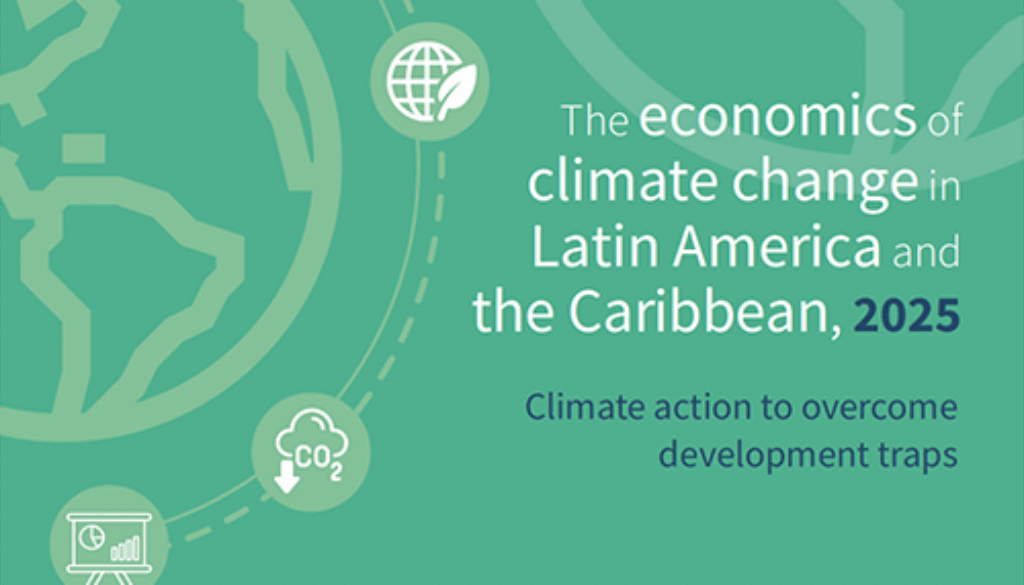
The economics of climate change in Latin America and the Caribbean, 2025: climate action to overcome development traps
Climate Economics with a Human Face: Why Latin America’s Transition Starts with Protecting Defenders
The Economic Commission for Latin America and the Caribbean’s 2025 report on the economics of climate change reframes the crisis as a structural development problem, not just a technical emissions challenge. It shows how rising temperatures, extreme events and ecosystem loss deepen long‑standing regional “traps” of low growth, high inequality and fragile governance, especially in countries that contributed least to global emissions. Read from the global South, this is an argument about justice: climate impacts are already shrinking people’s real possibilities to enjoy basic rights such as food, water, health and housing.
At the same time, the report positions climate action as an opportunity for a new development model, anchored in energy transition, sustainable mobility, bioeconomy and nature‑based solutions. This vision only holds if decisions about where and how these investments land are made with affected communities, not imposed on them. For environmental and land defenders—from Indigenous peoples to rural and urban movements—this is the frontline where macroeconomic transition either protects rights or reproduces dispossession under a green label.
The report calls for dismantling fossil fuel subsidies, scaling up renewables, pricing carbon, and aligning public budgets and financial systems with low‑carbon sectors. These are powerful levers, but they are not neutral. Without safeguards, a new wave of “green” projects can deepen socio‑environmental conflicts, fuel land grabs and expose defenders to more threats. The text itself warns that climate policy instruments can be regressive or generate unwanted social effects if distributional impacts are not addressed and if governance remains weak.
For a rights‑based climate agenda, this warning is a starting point, not a footnote. Who defines priority sectors and project locations? Whose consent is sought, and how? Which communities assume the risks of mining for transition minerals, large‑scale renewables or conservation schemes linked to carbon markets? Any serious response must put the safety, participation and land rights of defenders at the center of transition design—otherwise the region’s most exposed communities will again pay the price for other actors’ emission pathways and investment strategies.
The report explicitly highlights the Escazú Agreement as a key instrument to ensure access to environmental information, public participation and justice, particularly for people and groups in vulnerable situations. That reference matters: Escazú is the only binding regional treaty that names environmental human rights defenders and seeks to guarantee a safe environment for their work. Embedding Escazú in the climate discussion means recognizing that transparency, participation and accountability are not “soft” add‑ons, but hard conditions for effective and legitimate climate governance.
By connecting biodiversity, ecosystem services and financial risk, the report also acknowledges the historic role of Indigenous peoples and local communities in maintaining resilient territories, and the need to secure land tenure and correct power asymmetries with financial actors. This is precisely where defenders stand: holding the line against destructive projects while proposing alternative, life‑centered ways of organizing territory and economy. A climate economics that ignores their protection is incomplete. A climate economics that sees them as central political actors -rather than obstacles- moves closer to a genuinely just transition for the Global South.
Full report here: https://www.cepal.org/es/node/71296